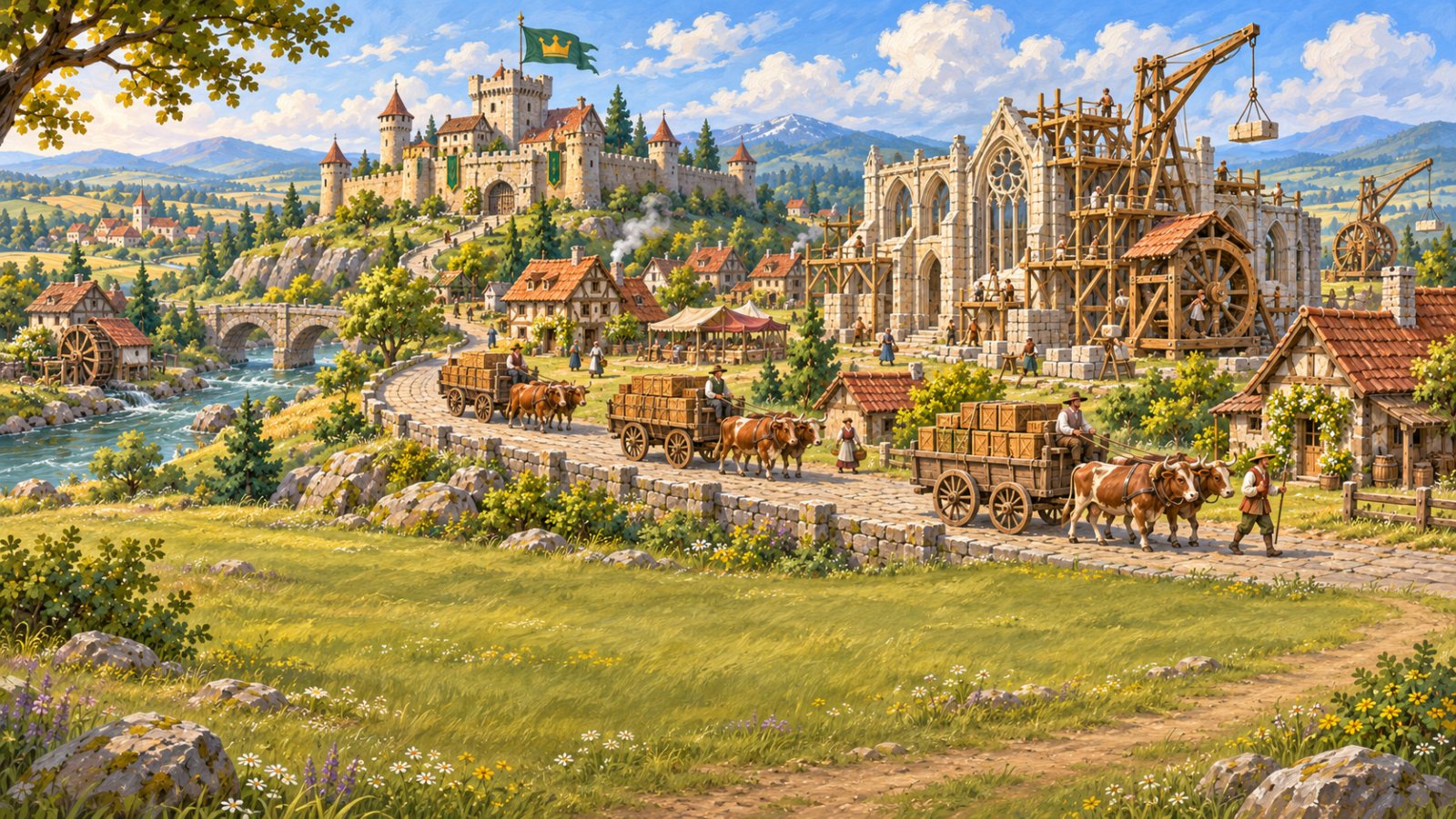
Hello again! Devlog #8 is 2 November, the day we rebuilt how roads work. Roads are most of what you do in Hearthroad: every good walks from one building to the next on a road you drew. That day they got simpler and fairer, and they started telling you when they're the problem. Everything below was filmed in the game as it was that night.
A road runs a set number of carts
Roads used to clog: when goods piled up, the road itself went red and "congested", and it was hard to tell what to do. Now nothing slows down. A road runs a set number of carts, and better roads, carts and research raise it. When every cart is out and goods still pile up at the start, the building at that end shows Road full, and rest on the road to see its load: "5 of 5 carts busy · 26 a minute at most".
Click the building and its problem names the next step: a better road surface, bigger carts, a research, or simply a second road.
From the dot you pick to the dot you pick
Every building has dots down its sides: goods come in on the left and go out on the right. A road used to pick its own dots once you'd drawn it. Now it plugs into exactly the dot you dragged from and the one you dropped on. Roads also run one way: if you want goods to go back, draw a road back.
Carts carry a few goods at once
A Porter carries one good. A Handcart has two slots, an Ox Cart or a Horse Wagon four, a Caravan six, and each slot holds one good. The building at the far end decides what fills them: the good it will run out of soonest goes first. If it's badly short of one thing, every slot carries that. On the map each cart shows a little picture for every slot.
Rest on a road and it lists what it carries, each good with how many a minute go along it.
And the rest of the day
Trouble now shows as a picture pinned over the building that has it, with badges at the screen's edge for what's out of view. One oak top bar holds your people, coins and stock. 49 deeds give you small goals with small rewards, high water runs over the bridges it has stopped, and the Workshop got 108 new painted steps. Every change is in the patch notes below.
What's next
Devlog #9 is 3 November: bots that play the whole game to the crown, so we can balance it. The game isn't open to play yet: leave your email on the home page and we'll write when it is.
Patch notes · 2 November 2026
22 changes- A market place's stalls take their goods in turn, so a Kingdom keeps growing past 2,600 people.
- Carts carry slots of goods, each slot one good, and the far end decides what it needs first.
- Deeds, Renown and the Legacy: 49 deeds with small rewards, picture lessons, and a hand-down from the City that buys lasting boons for your next realm.
- The late game: events that weigh on your goods, staged great works, a crown to win and an epilogue.
- 108 new painted Workshop steps, and paintings for the great works and the late events.
- Each late event has its own sound.
- The river's high water runs over the bridges on the map.
- Opt-in play data: the game asks once, shows exactly what it would send, and sends nothing without a yes.
- The ascension card shows what you gain in pictures, and warns you if people would leave.
- The first tiers hold: ascending strands nothing, the tutorial teaches the Storehouse, and settlers wait for food.
- Research can run side by side once the University allows it.
- The top bar keeps pause, the speeds, the date and the menu on screen at every width.
- A road shows the flow of each good it carries, per minute.
- Every tech needs a University first.
- One oak top bar holds your realm, people, coins and stock; research and the Workshop move to the build bar.
- A building's road dots follow how many goods it moves, and the Village Hall becomes the realm's seat.
- Roads run one way with no traffic jams; the good the far end runs out of soonest goes first.
- Painted glyphs and problem pictures replace the last line icons.
- Trouble shows as pictures: a pin over the card, and badges at the screen's edge for what's out of view.
- While placing, every building shows the room it keeps around it.
- A road plugs into exactly the two dots you drag it between.
- The book of knowledge opens faster, and the map runs smoother while it's open.
Behind the scenes: Every word in the game moved into one catalogue, the tests got sharper, and the bots learned the late game.